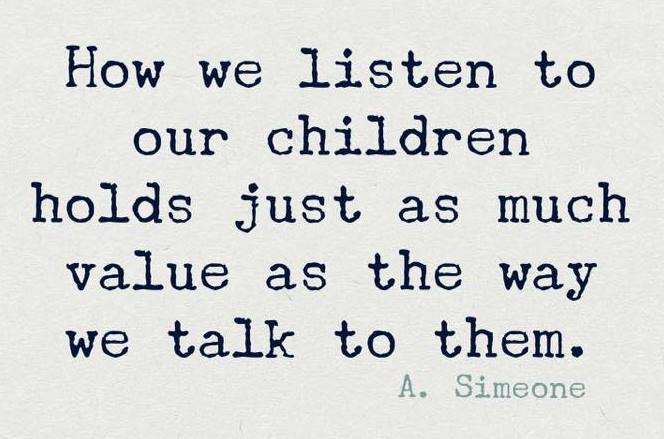
Who’s Listening?

How many opportunities to listen to kids are missed because grown-ups have so much else to do? I’ll be the first to admit that as a parent, I was often distracted and inattentive when my child was talking.  I’ll own up to being dismissive and assuming that their chatter was not as important as my tasks at hand.   I know better now.

You might describe my job as a forensic interviewer as “talking to kids,” but when I introduce myself to a child I prefer to explain that it was my job to listen.  Is listening to kids part of your job too?

As parents, grandparents, teachers, administrators, childcare providers you are truly the first responders to a child’s outcry. When a child has worked up the nerve to trust you with their most intimate fears, your response sets the tone, or trajectory, from then on…throughout the entire investigation and the child’s future.  Are you ready? Chances are you are not.

Would you be surprised to learn that a child can be more emotionally traumatized by being not believed than by what the offender did to them? It takes a lot of guts for kids to open up to a grown-up that another person has hurt them.  Many things get in the way:  fear of being embarrassed, fear of being blamed, fear of being punished, and even fear of causing harm to the offender who is most likely someone they care about.

Research on adverse childhood experiences tell us that child abuse can inflict lifelong damage if the adults who are supposed to come to a child’s aid don’t step in.  You don’t want to hear the words coming from a child that he or she has been touched inappropriately. Your first reaction, at a gut level, is to think and say “no!” or “that didn’t happen,” or “surely you misunderstood,” or worse… “you’re lying!” Those words have the power to crush a child’s spirit and chances of recovery…even though that is not your intent. Will you offer uplifting support, or trigger a downward spiral that confirms the child’s fears?

You must be ready to listen to the child’s message. Even with doubts racing through your mind, you can say “I’m sorry that happened to you,”  “I’m glad you were brave enough to tell me,” or “I’m here for you.”   Even without knowing all the facts, you respond in a way that puts the needs of the child first!  Thankfully, it’s not your job to determine what did or didn’t happen. That duty goes to the “next” first responders, trained law enforcement officers working alongside trained child protection workers who gather the evidence and determine if a crime occurred.

If you take the easy route and dismiss the child’s outcry, and fail to report it to the authorities as required by state law, you have left that child in the lurch…in harm’s way.  And you have left many other children in danger as well since statistically there are four other children harmed for every one of them that tells. Have you ever considered, before reading this, that listening gives you the power to help a victim of child abuse along the path to healing and provide safety to many others as well?

That’s where the Dearing House slogan of hearing helping healing comes from. The importance of hearing the child’s words allows us to help him or her and the family on the path to healing. But without your support as the first adult they trusted, they may never get that chance.   Who’s listening now?

Link

May I serve you a cup of Alphabet Soup?

Some of you may be surprised to learn that there was a time when I avoided public speaking at all costs!   I was a painfully timid child.  As late as 4th grade I couldn’t enter the classroom without being accompanied by my mother.  But something changed over the years.  Now I am happiest when I have an audience and today was a really good day.  I gave a talk at Rotary entitled “Alphabet Soup” to explain how Dearing House partner agencies (using acronyms….DHS, PCPD, KSO, OSBI, ICW, TPD, DA, SANE, EFCMHC, etc) work together to solve crimes against children.

Once I got over being shy, I love, adore, long to share information about Dearing House and our mission of hearing, helping, healing victims of child sexual abuse.   I’m very grateful for the opportunity to talk about the great work being done by the professionals on our MDT… one of many acronyms we use….referring to the Multidisciplinary Child Protection Team which includes child welfare, law enforcement agencies, medical and mental health professionals,  and others!  It’s always encouraging when people care enough to ask questions following the presentation.  This was a smart bunch of people who offered a lot of food for thought.

Nineteen years in the field of child protection (DHS before Dearing House) has taken its toll and sometimes I make the assumption (never a good thing) that others know how things work at Dearing House.  Responding to questions from the group opens my eyes to how child abuse is perceived by those who don’t work in day after day.  As much as I dreaded being called upon in 4th grade, I now love questions!

I learn from questions.  I was reminded today that terms like “child advocacy center, (CAC)” and “court appointed special advocate, (CASA)” are easily confused. Both programs provide advocacy…we need a sidebar to define that term…and both focus on victims of child abuse.  We just do it at different points along the continuum of intervention for abused kids.

The CAC…Dearing House…is ground zero, the very first stop in determining what, if anything, happened to the child.  The child and family come to us immediately following the disclosure of abuse.  Its our job to provide a setting and situation where the child victim, who is typically the only eye-witness to the crime, can provide as much detail as possible.

Next,  the professionals on our MDT (defined above) utilizes their broad range of expertise to determine how to keep the child safe, and to further investigate the alleged crime from all angles before presenting their findings to the District Attorney.

CASA (Court Appointed Special Advocates) have their opportunity to get involved once the child’s case reaches the court room.  The judge determines when to appoint a  CASA volunteer,  a trained “extra set of eyes,” to look after the needs of the child during the court process.  This could be weeks, if not months, after the child was interviewed at Dearing House, and many cases are cleared up without going to court and won’t involve CASA at all.  Likewise, many of the kids helped by CASA have not been to Dearing House.  Its more than the acronyms that can be confusing!

That’s your serving of “alphabet soup” for today.  From your questions, I can tell you want to know more about how all the agencies in this alphabet soup are effective and avoid duplicating services.  We are in agreement!  For example, the CASA Director and I discussed this article before I published it.  Dearing House serves a unique position to coordinate with all the agencies responding to child sexual abuse victims so that the needs of the child are never forgotten in the process….or lost in the alphabet soup.

Now that I’m over being bashful, I look forward to more of your questions!

Maggi Hutchason, Executive Director and MDT Coordinator!

logo pic


Are You the One?

Have you ever worried about how kids overcome terrible experiences like sexual abuse?

The single most important predictor of a child’s ability to survive the unthinkable is at least ONE stable relationship with a supportive parent, caregiver, or other adult!

Are you the one?

Of course, you are!  Maybe you didn’t realize it yet!

When you give a kid a high five for doing their best at a sporting event, you are complimenting the child’s abilities.  When you help a child with homework or read a book with them, you are strengthening their problem-solving skills.  When you take a child to visit a museum or go to a concert, you are sharing important traditions.  When you look a child in the eye and respond to their questions, you are showing the child he or she is valued.  And every time you do this, whether you are a parent, coach, relative, teacher, or neighbor, you are tipping the scales in their favor.  You are building resilience.

One way to understand the development of resilience is to visualize a seesaw or balance scale.  The Center of the Developing Child at Harvard University explains that a child’s positive experiences and coping skills on one side counterbalance adversity and abuse on the other. To tip the scale toward resilience, a child needs:

  • supportive relationships with adults,
  • opportunities to develop a belief in their own abilities and worth,
  • opportunities to strengthen problem-solving skills, and
  • sources of faith, hope and cultural traditions.

The next best lesson is that the very things you do to build resilience in a child can also decrease the likelihood they will become a victim.  Criminals are more likely to prey on children who are isolated, lonely, and neglected. When it is evident that children are reaching their full potential, supported by strong relationships in their family and community, the bad guys don’t stand a chance.  You have tipped the scales toward positive outcomes for kids!

Over 100 children come to Dearing House every year for help coping with abuse.  Every child who comes to Dearing House experiences a place where they feel important. Every child sees the team of strong adults working to protect them from further harm.  Every child hears that they are brave and strong and will no longer face evil alone.

We see resilient kids every day.  It was evident this week in 9-year-old Denise.  She admitted to being nervous about having to talk about what happened to her, but in spite of describing multiple incidents of hideous abuse, her words to me were “This was not so bad.”  I think she knew that the focus of everything we do here is about hearing, helping, and  healing.

DH street viewWe thank you for the ways you are the one building up kids and supporting Dearing House.  Now go tip the scales in favor of a child.

Click here for more info on resilience from Harvard


What’s the scariest thing you’ve ever done?

child scary faceMaggi Hutchason, Executive Director

Were you ever scared as a kid?  The scariest thing I can remember is getting lost.  I was a middle-schooler in the high school marching band and got separated after the parade in an unfamiliar city.  Found myself totally isolated from anything or anyone familiar.  And this was DECADES before cell phones.  With some help from a kind stranger, I was able to get back to the bus where the other band members were impatiently waiting this dorky kid so they could leave.  Scared me.

Most of the time I avoid scary. Very few of us, especially little children, want to do things that are scary.

If you ask nine-year-old Melissa what’s the scariest thing she’s ever done, she’ll tell you it’s talking to me. And you better believe her.

My job is to listen to kids describe how a person they cherish and adore has violated every tidbit of their trust, and probably every opening on their body.  I’m a Forensic Interviewer.

I don’t relish the idea of being a child’s scariest thing.  Dearing House doesn’t look scary.  There is a reason why the walls and furniture are colorful.  We go out of our way to make sure the child feels welcome and comfortable. The scary thing for a child is to find the strength to tell a secret when she has been threatened and bribed and groomed not to tell. Over 3/4 of child victims keep abuse a secret for at least a year, and many are too scared to ever tell. That’s what the offender is counting on.  Sexual abuse only happens in secret.

Was I brave to find my way back to the band bus?  I thought so at the time, but my “bravery” pales in comparison to the children I meet here at Dearing House every week.  It takes every ounce of their being to find the words to describe what happened to them, especially with doubts and fears about what will happen next.

Melissa was able to describe things that had been a horrible secret, but the most important thing she said was at the end of her interview: “I’m happy I came and talked to you.  I thought it would be scary, but I’m not scared anymore.”  

That’s bravery!  A child is no longer scared of the dark, dreadful secrets forced on her. The investigative team and process at Dearing House provided the safety net she needed to be brave.  And as a result of her bravery, the offender has lost his power over Melissa.

Here’s what we see every day, and what keeps us here every day: a child like Melissa crosses our threshold scared and worried, with a big burden on her little shoulders.  She finds a place and group of people who are willing and able to carry that burden for her, and in the end, she can say, “I’m happy I came and talked to you.”  In the course of an hour, years of secrets are released and immediate safety measures are put in place.  Score one for the good guys.

Every time we do this, a child is given a chance to be heard, to be believed, and to take the first steps toward healing.  We know it’s a scary thing…. you better believe it.